Small business email
The invoice email that gets paid: PDF or link, the due date in the subject, and the reminder at seven days
An invoice email has one reader who matters: the person who has to find it again in two weeks, check it against what they ordered, and press pay, or pass it to someone who can. Most late invoices aren't disputed. They're buried, forwarded to nobody, or waiting for a detail that wasn't in the email. Here's what the first email carries, whether to attach a PDF or send a link, what payment data says about net 15 and net 30, and the reminders with dates and wording, up to charging interest.
The short answer: put the invoice number, the amount and the due date in the subject, the way to pay in the body, and attach one small PDF for their records. Write the due date as a date ("Monday 16 November"), not "net 30". Send it from the address the client already writes to. Remind three days before, on the day, at 7 days late and at 14 days late, each time in the same thread.
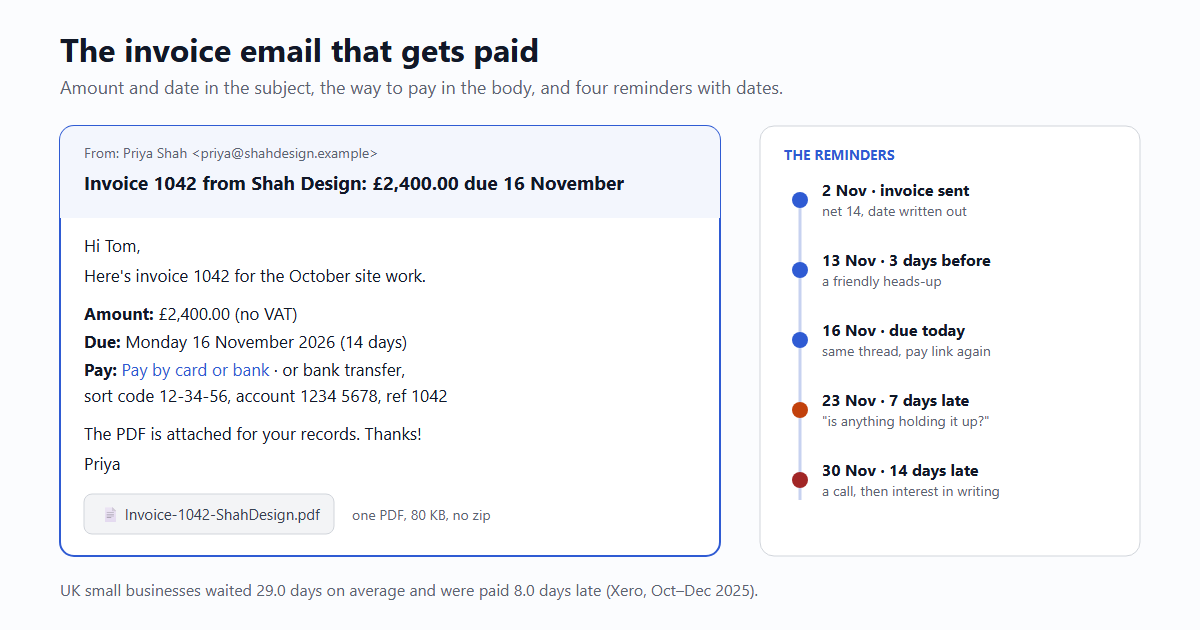
What the first email carries
Subject: Invoice 1042 from Shah Design: £2,400.00 due 16 November

Hi Tom,

Here's invoice 1042 for the October site work (the new booking
pages and the menu update).

Amount:   £2,400.00 (no VAT; not VAT registered)
Due:      Monday 16 November 2026 (14 days)
Pay:      https://pay.example/inv/1042  (card or bank)
          or bank transfer: Shah Design, sort code 12-34-56,
          account 1234 5678, reference 1042

The PDF is attached for your records. If anything on it looks
wrong, reply to this email and I'll fix it the same day.

Thanks,
Priya
Shah Design · priya@shahdesign.example · 07700 900123- The subject carries the search terms. Months later someone types "1042", "Shah" or "invoice" into their inbox. "Invoice 1042 from Shah Design: £2,400.00 due 16 November" is found by all three, and the amount and date are read before the email is opened.
- The amount in the body, with tax said once. If you charge VAT or sales tax, give the total and the tax line; if you don't, say so ("no VAT"), because a bookkeeper's first question is often "is this plus VAT?"
- The due date as a date with the weekday. Make it a working day: an invoice due on a Saturday gets paid on Monday at best.
- Every way to pay, in the email itself: a pay link, and the bank details with the reference to use. Someone paying from their phone shouldn't have to open a PDF to copy a sort code.
- What it was for, in a few words ("the October site work"), so a person who wasn't on the project can approve it.
- Who to ask: "reply to this email" only works if the reply reaches you (more on that below).
The PDF carries the parts tax rules ask for: your business name and address, the client's, a unique invoice number, the date, what was supplied, and, if you're VAT registered in the UK, your VAT number and the VAT at each rate. The email you send once it's paid is a different one; what that carries is in the receipt email.
PDF, pay link, or both
The largest public look at this comes from Tofu, a US invoicing app for trades, which published payment data for 3,750,978 invoices issued from January 2025 to May 2026 (median invoice $600). Among invoices sent by email, the ones that also carried an online payment link were paid more often and about twice as fast:
| Invoice sent | Invoices | Share paid | Median days to pay |
|---|---|---|---|
| Email with a payment link | 119,607 | 79.6% | 8 |
| Email without a link | 640,997 | 56.1% | 15 |
That's a correlation, not a test: businesses that bother with pay links may also chase harder. But the direction is what you'd expect, and the method matters too: in the same data, card payments through a link came in a median 1.5 days after the invoice, against 18 days for invoices paid by check.
The PDF still belongs in the email, because the client's accounts software or bookkeeper wants a file to keep. What trips filters is less the PDF than the pattern around it. "Invoice" is the oldest lure in phishing: Abnormal Security found that 18.4% of the credential-phishing emails people clicked in 2023 had invoice or payment words in the subject, the top theme. So a first invoice from an address the client has never written to, with "Invoice" in the subject and an attachment, looks exactly like what filters are tuned to catch. Business mailboxes on Microsoft 365 with Safe Attachments open attachments in a sandbox first, and Microsoft's documentation says that can delay safe messages too.
- One PDF, small, named for a person:
Invoice-1042-ShahDesign.pdf, a few hundred KB at most. Notscan0001.pdf, and never a zip: archives are a favourite place to hide malware, and many company filters strip or hold them. - No macros, no Word file asking the reader to "enable editing". A PDF exported from your invoicing app or word processor is fine.
- No "view your invoice" link to a file-sharing page that asks the reader to sign in. That is the shape of a credential-phishing email. A pay link to your payment provider's checkout is different: it asks for a payment, not a password.
- Write first, from the same address: with a new client, a short "I'll send the invoice for the deposit today" from your normal address, then the invoice as a reply in that thread, turns a stranger's attachment into an expected one.
Net 15 or net 30: what the data says
The same Tofu data shows how long clients actually took for each stated term. Longer terms got paid later, and most invoices with any due date were paid after it:
| Terms on the invoice | Share of invoices | Median days to payment | Paid after the due date |
|---|---|---|---|
| Due on receipt | 8.8% | 9 | 73.9% |
| Net 10 | 4.0% | 18 | 64.2% |
| Net 15 | 0.8% | 21 | 62.5% |
| Net 30 | 1.8% | 34 | 55.8% |
Read it two ways. Shorter terms do bring the money in sooner: net 15 invoices were paid a median 13 days before net 30 ones. And a due date doesn't make anyone pay on it: on net 30, more than half paid late. In the UK, Xero's figures for small businesses on its platform say the same: in October to December 2025 they waited 29.0 days on average to be paid, and payments arrived 8.0 days after the due date (8.4 days late over the whole of 2025).
What the difference is worth, worked out: a freelancer who invoices $4,000 a month and is paid on the net 30 median (34 days) has about $4,000 × 34 ÷ 30 = $4,533 out with clients at any time. On net 15, paid on its median (21 days), that's $4,000 × 21 ÷ 30 = $2,800: about $1,733 more in the bank, for the same work.
Whatever the terms, write the date. "Net 30" makes the reader count from a date they may not have (the invoice date? the day it arrived? the end of the month?). "Due Monday 16 November 2026 (14 days)" leaves nothing to count. If you agreed terms in a contract, the invoice repeats them; it can't add new ones after the work is done.
The reminders: dates and wording
Send each reminder as a reply in the original thread, so the invoice, the PDF and every earlier note are one click away. With the invoice sent on Monday 2 November and due on Monday 16 November:
| When | Date | Tone | What it adds |
|---|---|---|---|
| 3 days before | Fri 13 Nov | Heads-up | Amount, date, pay link. Two lines. Skip it for a client who always pays on time. |
| Due day | Mon 16 Nov | Plain | "Due today" and the pay link. Many accounts teams pay in a weekly run; this puts it in this week's. |
| 7 days late | Mon 23 Nov | A question | "Is anything holding it up?" and an offer to send it to whoever approves payments. PDF attached again. |
| 14 days late | Mon 30 Nov | Firm | A phone call first, then the email: a pay-by date and what happens after it (interest, the fixed sum, pausing work). |
| 30 days late | Wed 16 Dec | Final | Interest added on a new statement; a last date before a formal letter or a small claim. |
Three days before:
Subject: Invoice 1042: £2,400.00 due Monday

Hi Tom, a quick heads-up that invoice 1042 (£2,400.00) is due on
Monday 16 November. The pay link is here if it's easier:
https://pay.example/inv/1042

Thanks, Priya
Seven days late. It asks a question because the usual answers are boring and fixable: it went to the wrong person, it needs a purchase order number, it's waiting for a signature.
Subject: Re: Invoice 1042 from Shah Design: £2,400.00 due 16 November

Hi Tom,

Invoice 1042 for £2,400.00 was due on Monday 16 November and I
haven't seen it come in yet. Is anything holding it up? If it's
waiting on someone else to approve, tell me who and I'll send it
to them directly.

Pay link: https://pay.example/inv/1042
The invoice is attached again.

Thanks, Priya
Fourteen days late, after a phone call. It gives a date and says exactly what follows, with the numbers:
Subject: Re: Invoice 1042: £2,400.00, now 14 days overdue

Hi Tom,

Invoice 1042 (£2,400.00, due 16 November) is now 14 days overdue.
I tried to call this morning and left a message.

Please pay by Friday 4 December. After that I'll add statutory
interest of 11.75% a year (77p a day on this invoice) and the
£70 fixed sum under the Late Payment of Commercial Debts
(Interest) Act 1998, as my terms say.

Pay link: https://pay.example/inv/1042

Priya
What doesn't help: "just following up" with no amount or date, a new email thread each time, copying the client's boss on the first reminder, and anything sarcastic. What does: the amount, the date and the pay link in every reminder, and asking for a name to send it to if the first reader can't pay it.
Charging interest on a late invoice in the UK
Between businesses in the UK, the Late Payment of Commercial Debts (Interest) Act 1998 lets you claim interest and a fixed sum on a late invoice unless your contract sets its own rate. The statutory rate is 8% plus the Bank of England base rate: the base rate on 30 June for invoices falling due from July to December, and on 31 December for January to June. The base rate has been 3.75% since 18 December 2025, so for July to December 2026 the rate is 11.75% a year. If no payment date was agreed, interest runs from 30 days after the work was done or the invoice arrived, whichever is later. The fixed sum depends on the size of the debt, once per invoice:
| Invoice amount | Fixed sum you can add |
|---|---|
| Up to £999.99 | £40 |
| £1,000 to £9,999.99 | £70 |
| £10,000 or more | £100 |
Worked for invoice 1042, £2,400 due 16 November 2026 and paid on 16 December, 30 days late:
| Step | Sum | Result |
|---|---|---|
| Interest a year | £2,400 × 11.75% | £282.00 |
| Interest a day | £282.00 ÷ 365 | £0.77 |
| Interest for 30 days | £282.00 ÷ 365 × 30 | £23.18 |
| Fixed sum (£1,000 to £9,999.99) | £70.00 | |
| You can claim | £93.18 |
On small invoices the fixed sum is most of it: a £600 invoice two weeks late earns £2.70 of interest (£600 × 11.75% ÷ 365 × 14) but still the £40. Whether to claim from a client you want to keep is your call; saying in your terms, and in the 14-day reminder, that you can often gets the invoice paid without claiming. The Act covers business to business only, not consumers.
Elsewhere: in the EU, the Late Payment Directive (2011/7/EU) sets interest of at least 8 percentage points over the European Central Bank's reference rate and a fixed €40 per late invoice, through each country's own law. The US has no federal rule for private invoices; the rate is whatever your contract says, within state limits. Freelancers in New York City have had the Freelance Isn't Free Act since 2017: for work of $800 or more (counting the last 120 days) the client must sign a written contract, and if it names no payment date, payment is due within 30 days of the work being finished. New York State passed a similar law in 2024.
Which address it comes from
Send invoices from the address the client already knows: priya@shahdesign.example, not billing-noreply@ something. Replies to an invoice are the useful kind ("can you add our PO number?", "it's with finance now"), and they have to reach a person. If your invoicing app sends for you, set its reply address to your own mailbox and send yourself a test to see where a reply lands.
The same goes when your own app sends invoices through an email API: the sender can be the app, but the Reply-To should be a mailbox someone reads. email59's /v1/send takes a reply_to for exactly that (docs), and Reply-To on a no-reply sender explains the addresses on every email. For subscription charges that fail on a card, rather than invoices, see the missed-payment email.
One rule protects both sides: never change bank details by email alone. Invoice fraud works by sending the client a convincing "our bank details have changed" email. Put a line on your invoices that your details won't change without a phone call, and if a supplier's details change, call them on a number you already had.
Send app email with your own reply address One call sends it; the reply goes to your own mailbox.
Sources: Tofu, "How long do clients actually take to pay?" (3,750,978 US invoices, Jan 2025 to May 2026, computed Aug 2026); Xero UK Small Business Insights, UK update (26 Feb 2026); Abnormal Security, most popular phishing themes (2023 data, Feb 2024); Microsoft Learn, Safe Attachments in Microsoft Defender for Office 365; GOV.UK, "Late commercial payments: charging interest and debt recovery"; Late Payment of Commercial Debts (Interest) Act 1998 and the Late Payment of Commercial Debts Regulations 2013; Bank of England Bank Rate history (3.75% since 18 Dec 2025); Directive 2011/7/EU; New York City Freelance Isn't Free Act (2017).
Xero, Microsoft 365 and Tofu are trademarks of their owners. email59 is not affiliated with them. This article is general information, not legal advice.