 email
Small business email
Back in stock: the restock email a small shop may send, and the waitlist that makes it allowed
Someone clicked "Email me when it's back" on your sold-out apron. That click is the whole permission: one email, when the apron is in stock, and then they come off the list. Here is how to build that for a small shop: the form, the email, who to send to first when you have 12 aprons and 90 people waiting, what the published figures say (and how shaky they are), and what the US, UK and EU rules mean for it.
The short answer: one sign-up, one email. The form says exactly that, the email shows the item, the price now, how many are in stock and one link to that item, you send in sign-up order and no more people than you can fill, and after the email the person leaves the waitlist for that item. Sell or promote anything else in that email and it stops being the thing they asked for.
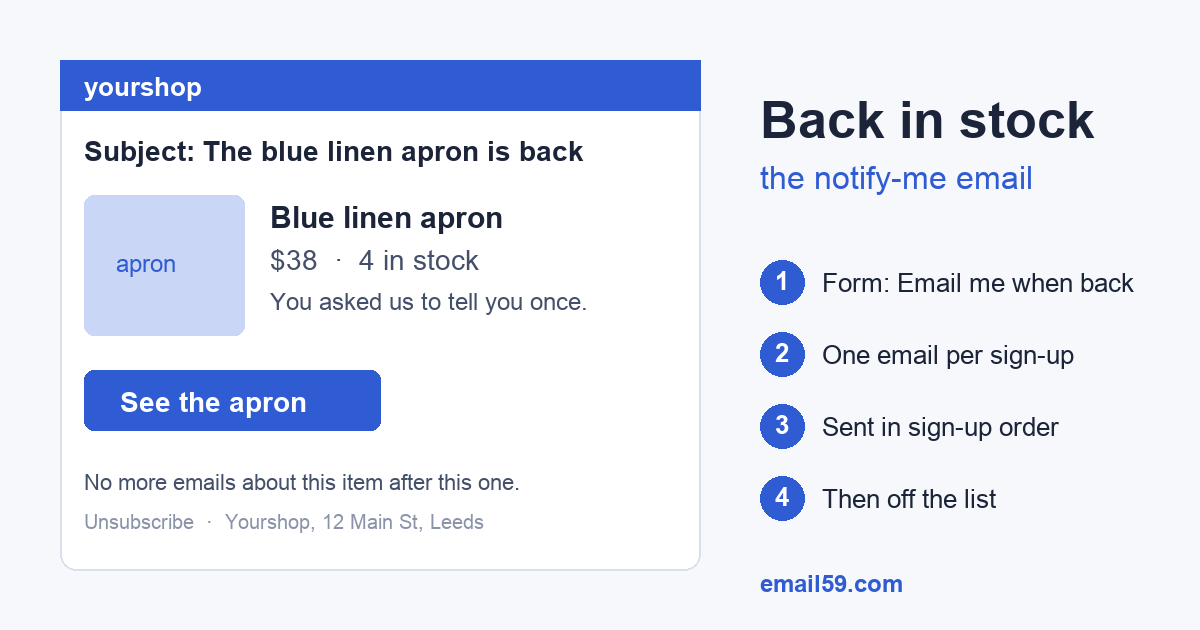
The notify-me form is the consent
- Ask for the email address and nothing else. The product is already known from the page. No name, no phone, no birthday.
- Say what happens, next to the button: "Email me once when this is back in stock. That is the only email about it." A line like that is what makes the sign-up specific and informed, which is what consent rules ask for.
- Keep a newsletter box separate and unticked. If you also want them on your newsletter, a second box, off by default, with its own words. Don't hide it inside the notify button. A person who wanted one email did not agree to a weekly one.
- Pick the variant. Size M in blue, not "the apron". Notify for the exact variant that was out, or the email arrives for a size they can't wear.
- Store the sign-up time, the item and the exact wording shown. That record is your proof later. It is three columns in a table.
- Confirm or not? A confirmation email ("click to confirm you want this") doubles your emails and, for people who never click, loses the sign-up. Some waitlist apps do it (Dotdigital's back-in-stock setup does); many shops skip it because the alert itself is a one-time email to an address the person just typed. The cost of skipping: typos and addresses typed for someone else. Catch the typo at the form instead.
What the numbers say
| Figure | Back in stock | Abandoned cart |
|---|---|---|
| Open rate | 59.19% | 50.5% |
| Placed-order rate | 5.34% | 3.33% |
| Revenue per recipient | $9.14 | $3.65 |
| Click rate | about 5.6% (the all-flow average, not specific to restock) | 6.25% |
These come from a flow-benchmark summary dated 8 October 2026 that says it is based on 2026 Klaviyo platform data (CartStrings). It gives no sample size or method, and other write-ups of the same $9.14 figure attribute it differently, so read it as a direction: a restock email earns roughly two and a half times what a cart reminder does per recipient, because the person asked for it. Apple Mail Privacy Protection inflates open rates, so the 59% is the least reliable number in the table. We found no published figure for the opt-in rate of a notify-me form, and none from a shop smaller than a few hundred orders a month. Use your own count instead: sign-ups, emails sent, orders within 48 hours.
What the email shows
- Subject with the item and the news: "The blue linen apron is back". Add the size if there are several: "Blue linen apron, size M, is back".
- The item, its picture, the price now. If it changed since they signed up, say so: "Now $42 (was $38)". Never let them find out at checkout.
- How many. "4 in stock" is useful when it is true, because it tells them to hurry or not to. If the number is not live, leave it out; a made-up scarcity line is a deceptive practice under the FTC Act and the UK's DMCC Act 2024.
- One link, to that item's page with the right variant selected, not your home page.
- One sentence of why they got it: "You asked us to email you when this was back. This is the only email about it."
- The footer you would add to any marketing email: unsubscribe link and your postal address. It costs nothing and covers you if a regulator reads it as marketing.
- Leave out "you may also like", a discount, or a newsletter pitch. That is the part that turns a requested message into a promotion.
Who to send to first when stock is short
If you tell all 90 people about 12 aprons, the first dozen buy, and the other 78 get a "sold out" page from the email they were waiting for. That is how a good list turns sour. Waitlist apps handle it two ways: AMP's Back in Stock lets you set a minimum inventory (its example: only notify when there are at least 5 units) and order the queue oldest first; DemandLoop describes a fair queue that notifies the first N subscribers in sign-up order in proportion to stock. Shopify's own alerts, by one guide's account, go to everyone who signed up. You can do the same by hand.
A worked example. 12 aprons arrive. 90 people are on the list. You don't know how many will buy, so work it out for three cases. To sell 12 units you need to email about 12 divided by the share who buy:
| Share of notified people who buy | Emails needed for 12 units | Fits in the 90? |
|---|---|---|
| 5% (the all-recipient placed-order rate above) | 240 | No: the whole list is not enough |
| 15% | 80 | Yes, nearly all of it |
| 30% | 40 | Yes, about half |
Rule of thumb that follows: start with about twice the units (24 emails, oldest sign-ups first), wait 2 hours, count what sold, then send the next batch sized to the remaining units divided by the share that bought so far. If 6 sold from 24 emails (25%), 6 left need about 24 more emails. Stop when the last unit goes; anyone not reached stays on the list for the next restock, and you can tell them so on the form. The 30%, 15% and 5% rows are cases to plan with, not benchmarks; the only sourced figure is the 5%.
After the email: off the list
- Remove the sign-up for that item once the email goes out. Not when they buy. If they don't buy and you restock again next month, they get nothing unless they sign up again, which is what the form said.
- Expire old sign-ups. Someone who asked 14 months ago may not want it. Canada's anti-spam law gives implied consent after an inquiry for 6 months only, a handy yardstick even if you don't sell there. Drop entries after 6 to 12 months.
- Keep the sign-up separate from the newsletter list. An unsubscribe from the restock email should not remove them from orders, and joining the waitlist should not add them to marketing.
- If they unsubscribed from your newsletter before, the restock alert they asked for is a different request. Some email tools suppress it anyway; Klaviyo's own docs advise also subscribing the profile to a list so the alert still goes out to someone who previously opted out of marketing. Check what your tool does, or you will lose the sign-ups people paid attention to.
What the rules say
| Where the person is | Rule | What it means for the restock email |
|---|---|---|
| United States | CAN-SPAM judges the primary purpose of the message. Commercial messages need an honest subject, your postal address and a working opt-out; no prior consent is needed. | A requested alert for an item you sell is a close call. Treat it as commercial: footer with unsubscribe and address. That is safe either way. |
| United Kingdom | PECR: marketing email needs consent or the soft opt-in (existing customers, similar products, a way to refuse). The ICO says genuine service messages are not marketing, and that an email can fall on the marketing side. | A one-off email the person asked for, with no promotion in it, sits closest to a service message. Add anything promotional and you need the consent of a marketing email. We found no ICO guidance on restock alerts specifically. |
| EU | ePrivacy plus GDPR: consent must be specific and informed. Most countries have a soft opt-in for existing customers, with their own variations. | The form wording is your consent record. "Email me once when it is back" is specific; a pre-ticked newsletter box is not. |
| Canada | CASL: express or implied consent; an inquiry gives implied consent for 6 months. | The sign-up counts as an inquiry about the item. Use it within the window. |
The pattern across them: what the person asked for is fine; extra selling in the same email is the risk. The same split drives transactional versus marketing, and it is why a restock email with a discount code in it is a marketing email while "it is back, $38, 4 left" is much nearer the other side. A cart reminder is different: nobody asked for it, so see the abandoned-cart email for that.
Sending it from your shop
If your shop platform has restock alerts, turn them on, set a minimum stock and the oldest-first order if the setting exists, and check the footer. If you built the shop yourself, a row per sign-up (email, item, variant, time, wording) and a job that runs when stock goes from 0 to more than 0 is enough. Send it with the marketing category if you want the unsubscribe link and unsubscribe list handled for you. With email59 that is one call:
curl https://email59.com/v1/send \
  -H "Authorization: Bearer $EMAIL59_KEY" \
  -H "Content-Type: application/json" \
  -d '{
    "from": "yourshop",
    "to": "alex@example.com",
    "category": "marketing",
    "reply_to": "hello@yourshop.example",
    "subject": "The blue linen apron is back",
    "template": "notice",
    "heading": "It is back",
    "text": "You asked us to email you when this was back. This is the only email about it.\n\nBlue linen apron, size M: $38, 4 in stock.",
    "button_text": "See the apron",
    "button_url": "https://yourshop.example/aprons/blue-linen?size=m"
  }'
Role addresses (info@, sales@) and addresses that unsubscribed are refused with the marketing category, so a sign-up from someone who opted out of everything will not go through; delete the sign-up and tell them if that matters to you. Then delete the waitlist row for that item.
Sources: CartStrings, "Klaviyo flow benchmarks 2026" (8 Oct 2026; secondary, no sample size given); Klaviyo Help Center, "Understanding how back in stock flows work", and Klaviyo developer docs on back in stock via API; Dotdigital, "Set up back in stock alerts for Shopify"; AMP Back in Stock and DemandLoop fair-queue documentation; ICO guidance on direct marketing using electronic mail and the PECR guide; FTC, "CAN-SPAM Act: A Compliance Guide for Business"; Canada's Anti-Spam Legislation, implied consent from an inquiry (6 months). Vendor documentation describes the vendor's own behaviour; it is not independent evidence.
Klaviyo, Shopify, Dotdigital, AMP and DemandLoop are trademarks of their owners. email59 is not affiliated with them. This article is not legal advice.