Small business email
The abandoned-cart email: one reminder, at the right hour, and what a small shop may send without consent
About seven in ten online carts are left before paying; Baymard Institute's average of 49 studies is 70.22% (September 2025). Most of those people were only looking, and no email brings them back. Some of them got distracted, or the shipping cost surprised them, and one well-timed email does bring them back. This is that email for a small shop: when it goes, what it shows, how many to send, and what the rules let you send to someone who never bought anything.
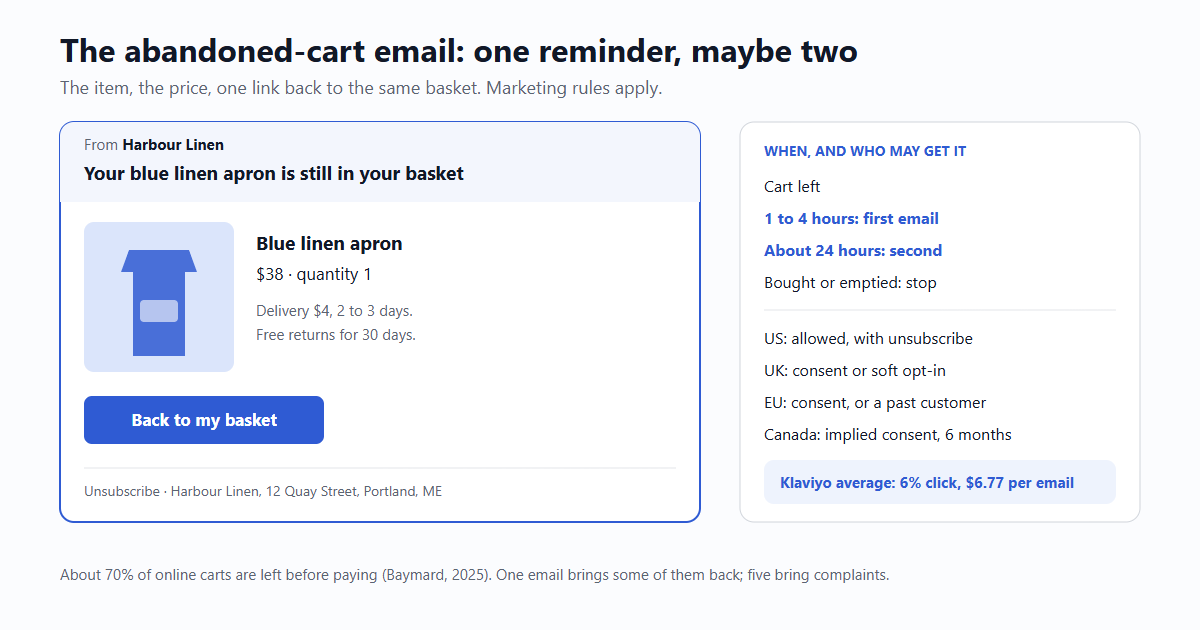
The short answer: send one reminder 1 to 4 hours after the cart is left, and at most one more about 24 hours later. Show the item, its picture, the price and one link back to the same cart. In the US it is a marketing email (unsubscribe link and postal address). In the UK it needs consent or the soft opt-in, and in much of the EU it needs consent unless the person has bought from you before.
What the numbers say
| Figure | Value | Source |
|---|---|---|
| Carts left before paying (average of 49 studies) | 70.22% | Baymard Institute, Sept 2025 |
| Abandoned-cart email click rate | 6.0% average, 11.3% for the top 10% of brands | Klaviyo, 110,000+ customers, Oct 2026 |
| Revenue per email sent | $6.77 average, $13.70 top 10% | Klaviyo, Oct 2026 |
| Open rate | 50.5% average, 65.3% top 10% | Klaviyo, 2023 data (published 2024) |
| Orders placed per email sent | 3.33% average, 7.69% top 10% | Klaviyo, 2023 data |
| Three reminders compared to one | 131% more orders | Omnisend (vendor figure, no method given) |
An open rate of 50% is about double what a newsletter gets, because the email is about something the person did an hour ago. That is also why it works best soon.
A worked month. A small shop has 1,000 carts left in a month. It only knows the email address for the ones where the person typed it into checkout or was signed in; say 350. At Klaviyo's averages, 350 emails bring about 12 orders (3.33%) and about $2,370 in sales ($6.77 each). The shop's own number will differ with its prices; the point is that one email to 350 people is worth setting up, and that the other 650 carts can't be emailed at all.
When it goes
- First email: 1 to 4 hours after the cart is left. Klaviyo describes a common sequence starting at 2 to 4 hours; Shopify's setting offers delays from 1 hour, and Shopify only counts a checkout as abandoned after a stretch without activity, so "1 hour" is really closer to 2. Sooner than an hour and the person may still have the tab open; they'll feel watched.
- Second email, if any: around 24 hours later. Same item, same link, perhaps a line about delivery times or the returns policy, which answers the usual reasons people stop (extra costs at checkout top Baymard's list).
- Then stop. Cancel the remaining emails the moment the person buys, empties the cart, or unsubscribes.
No study we could find compares a first email at 1, 4 and 24 hours on the same shops with published method; vendors recommend the first few hours, and a shop with expensive, considered items can wait longer. Test it on your own shop if you have the volume.
Why one or two, and not five
- Each one is marketing. Every extra email needs the same consent and unsubscribe, and every unsubscribe takes the person off your newsletter too.
- Spam complaints count against your whole shop. Gmail asks bulk senders to keep reported spam under 0.3% (the 2024 rules). Five reminders about a $20 item is how a shop's order confirmations start landing in spam.
- A discount in the first email teaches people to leave carts. If you want to offer one, keep it for the second email, and only for carts above a set amount.
What the email shows
- Subject with the item: "Your blue linen apron is still in your basket". Not "You forgot something!", which reads like every other shop.
- The item, its picture, the price and the quantity, as in the cart. If the price has changed since, say so.
- One button back to the same cart, already filled. A link to the home page loses most of the people who click.
- One line that answers a doubt: delivery cost and time, or "free returns within 30 days".
- The footer: unsubscribe link, the shop's name and postal address.
Leave out "only 2 left!" unless it is true; a false scarcity claim is a deceptive practice under the FTC Act and the UK's DMCC Act 2024 alike.
What a small shop may send without consent
| Where the person is | Rule | What it means for the cart email |
|---|---|---|
| United States | CAN-SPAM: no consent needed; an email whose main purpose is to sell is commercial | Allowed to anyone who gave you their address, with an unsubscribe link that works for 30 days, your postal address and an honest subject. It is not transactional: that exemption covers a transaction the person "has previously agreed to", and an unpaid cart is not one. Penalty up to $53,088 per email (2025 figure). |
| United Kingdom | PECR: consent, or the soft opt-in for "an existing customer who bought (or negotiated to buy)" similar products, with an opt-out offered when the address was collected | Fine if they ticked a marketing box, or bought before. A first-time visitor who only typed an email into checkout is a grey area; the ICO gives no basket example. Safe course: an opt-out box at the email field, and one email only. |
| European Union | ePrivacy Directive art. 13: consent, or the existing-customer exception "in the context of the sale" | Stricter than the UK in practice: in Germany (UWG § 7(3)) the exception needs a completed sale, so a first-time visitor gets no reminder without consent. |
| Canada | CASL: express or implied consent; an inquiry gives implied consent for 6 months | A cart left by someone who gave their email can count as an inquiry; keep the date. |
The practical setup that works everywhere: at the email field in checkout, one line "Email me about my order and basket" with a box, ticked or unticked by the rules where you sell; send the reminder only when the box is on, or when the person has bought from you before. The line between this and a real order email is in transactional or marketing.
When it is transactional instead
Two near-cousins are not cart reminders and need no consent: the email when a payment failed on an order the person placed ("your card was declined; your order is held for 24 hours"), and the receipt once they pay (what it carries). Keep the selling out of those, or they become marketing too.
Sending it from your shop
If your shop platform has the reminder built in (Shopify, WooCommerce with a plugin, Squarespace), switch it on and set the delay and the recipients. If you built the shop yourself, schedule the email when the cart gets an address, cancel it on purchase, and send it with the marketing category so the unsubscribe link and the unsubscribe list are handled for you. With email59 that is one call:
curl https://email59.com/v1/send \
  -H "Authorization: Bearer $EMAIL59_KEY" \
  -H "Content-Type: application/json" \
  -d '{
    "from": "yourshop",
    "to": "alex@example.com",
    "category": "marketing",
    "reply_to": "hello@yourshop.example",
    "subject": "Your blue linen apron is still in your basket",
    "template": "notice",
    "heading": "Still thinking it over?",
    "text": "Your blue linen apron ($38) is still in your basket.\n\nDelivery is $4 and takes 2 to 3 days. Returns are free for 30 days.",
    "button_text": "Back to my basket",
    "button_url": "https://yourshop.example/cart/c8f2a1"
  }'
Addresses that unsubscribed or are role addresses (info@, sales@) are refused with the marketing category, so a reminder can't go to someone who already said no.
Sources: Baymard Institute cart abandonment rate list (updated 22 Sept 2025); Klaviyo "Abandoned cart benchmarks" (2 Oct 2026) and the 2024 edition with 2023 data; Omnisend ecommerce email statistics; Shopify Help Center "Abandoned checkouts" and Shopify Community on when a checkout counts as abandoned; FTC "CAN-SPAM Act: A Compliance Guide for Business" and 16 CFR 316.3; FTC civil penalty adjustments (Jan 2025); ICO "Electronic mail marketing" guide (Oct 2026); Directive 2002/58/EC art. 13; German UWG § 7(3); CRTC on CASL implied consent. The worked month is our own arithmetic on Klaviyo's averages.
Klaviyo, Omnisend, Shopify, WooCommerce and Squarespace are trademarks of their owners. email59 is not affiliated with them. This article is not legal advice.