Account emails
Your trial ends Friday: the trial-ending email that doesn't feel like a trap
A free trial that turns into a charge nobody remembered agreeing to is the fastest way to a refund request, a chargeback or a one-star review. The email that prevents it is short: the date, the amount, what happens if they do nothing, and one way out. Card networks and several US states also say when it has to arrive. Send it seven days before the trial ends and you meet all of them at once; the table below shows why.
The short answer: send the reminder 7 days before the first charge, put the date and the exact amount in the subject and the first line, say plainly what happens if they do nothing, and give one link that cancels without a phone call or a chat. If the trial didn't ask for a card, the email is an invitation, not a warning, and it can be friendlier. Either way, send one more email the day the trial ends.
Why seven days, and not the night before
An email the evening before a charge reads like a formality: the person sees it at breakfast, after the card has already been charged in their time zone. The rules that apply to a small app point to the same window from different directions:
| Who sets it | Which trials | When the reminder must arrive | Source |
|---|---|---|---|
| Visa (since April 2020) | A trial or promotional price that turns into a recurring charge | At least 7 days before the first charge, with a link to cancel | Visa merchant notice, quoted by Olshan Frome Wolosky, Nov 2019 |
| Mastercard (since September 2022) | Digital goods and services, trials longer than 7 days | No less than 3 and no more than 7 days before the trial ends; cancel online | Mastercard rule as summarised in Braintree's docs |
| California, B&P § 17602 | Free trial or gift longer than 31 days | 3 to 21 days before the trial ends | Text current 1 Jan 2026 |
| New York, GBL § 527-a | Free trial longer than one month | 3 to 21 days before the cancellation deadline | NY Senate, rev. Nov 2025 |
| Minnesota, § 325G.57 (from 1 Jan 2025) | Free trial longer than 30 days | 5 to 30 days before the trial ends | MN Revisor |
| Virginia, § 59.1-207.46 | Free trial longer than 30 days | Within 30 days of the end of the trial | Virginia Code |
| Stripe Billing (setting) | Any trial on a subscription | Stripe's own reminder email goes 7 days before; the trial_will_end webhook fires 3 days before by default | Stripe docs, Oct 2026 |
Seven days before the end is inside every one of those windows: Visa's "at least 7", Mastercard's "3 to 7", California and New York's "3 to 21", Minnesota's "5 to 30", Virginia's "within 30". A shorter trial changes nothing for the card networks; Visa asks that trials of 7 days or less carry the end date and the cancel link in the very first confirmation email.
A worked date
A 45-day trial (long enough to bring in the California, New York, Minnesota and Virginia rules) starts on Sunday 1 November 2026.
- Trial ends: 1 November + 45 days = Wednesday 16 December 2026. The first charge is that day.
- California and New York window: 3 to 21 days before, so 25 November to 13 December.
- Minnesota: 5 to 30 days before, so 16 November to 11 December.
- Mastercard: 3 to 7 days before, so 9 to 13 December. Visa: on or before 9 December.
- The one date in all of them: Wednesday 9 December. Schedule the reminder for that morning in the customer's time zone, or around 15:00 UTC if you don't know it, which is morning in the Americas and afternoon in Europe.
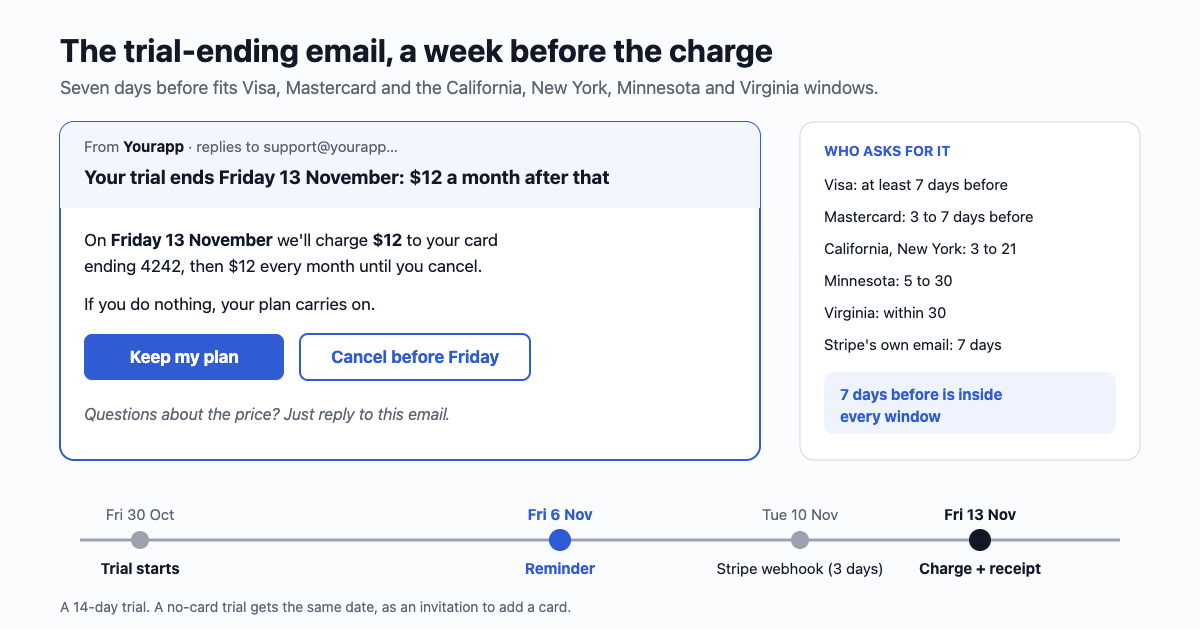
For a 14-day trial starting Friday 30 October, the charge is Friday 13 November and the reminder goes Friday 6 November. In code it is one subtraction: reminder_at = trial_end - 7 days. If the trial is shorter than 7 days, send it with the sign-up confirmation.
What the email says
- Subject with the date and the amount: "Your trial ends Friday 13 November: $12 a month after that". People search their inbox for the charge later; this is the email they'll find.
- First line, the whole deal: "On 13 November we'll charge $12 to your card ending 4242, then $12 every month until you cancel." Weekday and date, amount with the currency, the last four digits, and how often.
- What happens if they do nothing, in one sentence. For a card-required trial: the charge. For a no-card trial: "your account switches to the free plan; nothing is deleted" (or whatever is true).
- Two buttons of equal weight: "Keep my plan" and "Cancel before Friday". The cancel link opens a page where one more press cancels. California has required online cancellation with "a prominently located direct link or button" since July 2025, and a save offer only if the cancel button is shown at the same time.
- What they keep if they cancel: access until the end of the trial, their data for how long, how to export it.
- A reply that reaches someone. "Questions about the price? Reply to this email." A person who replies instead of cancelling is a customer you can still keep.
Leave out the upsell to the annual plan, a countdown timer and "Don't lose your progress!". Each makes it read like the trap it is trying not to be.
Card or no card changes the tone, not the date
| Card required at sign-up | No card at sign-up | |
|---|---|---|
| Conversion to paid (ChartMogul and ProductLed, 200 products, Jan 2026) | About 30%; 25 to 35% counted as good | 4 to 6% counted as good; card-required converts at more than 5 times the rate |
| What the reminder is | A notice before a charge: legally required in the states above, required by Visa and Mastercard | An invitation to add a card; no charge happens, so no rule sets a date |
| Subject | "Your trial ends Friday 13 November: $12 a month after that" | "Your trial ends Friday: keep your projects on the $12 plan" |
| If they do nothing | They're charged. Say so in the first line | They drop to the free plan or lose access. Say which, and what happens to their data |
| Main button | Two equal buttons: keep, cancel | One button: add a card |
The card-required figure is higher because people who don't intend to stay don't sign up. It also brings the people who forgot, and they are the ones who dispute the charge. Each dispute costs a US Stripe account a $15 fee whether you win or lose, and since June 2025 another $15 if you contest it and lose; too many of them put the account on a card network monitoring list.
The day the trial ends
Two emails, and only one of them goes out:
- The charge went through: the receipt, with "your trial ended and your first payment of $12 was taken" in the first line and the cancel link again. What a receipt has to carry is in the receipt email. Stripe appends "* TRIAL OVER" to the card statement descriptor of that first charge; matching words in the email help the customer connect the two.
- The charge failed, or there was no card: "Your trial has ended. Your projects are kept for 30 days; add a card to carry on." If a card was declined, that is a missed payment, not an ended trial: the missed-payment email covers what to say so people update it.
The US rules behind it, and where they stand in October 2026
- The FTC's "click-to-cancel" rule is gone, for now. It was issued in October 2024 and struck down in full by the Eighth Circuit on 8 July 2025, days before most of it took effect, because the FTC skipped a required preliminary analysis. The FTC started again with an advance notice in March 2026 (comments closed 13 April 2026); there is no proposed rule yet.
- ROSCA still applies to any online subscription sold in the US: disclose the material terms clearly before taking billing details, get express informed consent before charging, and give "simple mechanisms" to stop the charges (15 U.S.C. § 8403). It is the law behind the large cases: Amazon's $2.5 billion settlement over Prime sign-ups and cancellation (September 2025), Adobe's $150 million settlement with the Department of Justice (March 2026), Chegg $7.5 million and Match $14 million (2025).
- State laws carry the dates in the table above, plus their own extras: California also wants a reminder once a year for annual plans and 7 to 30 days' notice of a price change; New York 5 business days to 30 days' notice of a price change; Minnesota a reminder at least once a year.
- The UK has its own subscription rules under the Digital Markets, Competition and Consumers Act 2024. The draft regulations were laid before Parliament on 19 October 2026 to start on 1 January 2027: a reminder before a free trial first turns into paid, at a "reasonable" time the business states up front, and 14 days to cancel after the trial converts.
This is a summary for planning emails, not legal advice for your business.
Sending it from your app
The reminder is a transactional email: it goes to everyone on a trial, including people who never joined a newsletter, as long as it sticks to the trial (where the line is). Schedule it when the trial starts, so a missed webhook can't skip it, and cancel the job if the person cancels first. With email59 it is one call, with replies going to an inbox someone reads:
curl https://email59.com/v1/send \
  -H "Authorization: Bearer $EMAIL59_KEY" \
  -H "Content-Type: application/json" \
  -d '{
    "from": "yourapp",
    "to": "sam@example.com",
    "reply_to": "support@yourapp.example",
    "subject": "Your trial ends Friday 13 November: $12 a month after that",
    "text": "Hi Sam,\n\nOn Friday 13 November we will charge $12 to your card ending 4242, then $12 every month until you cancel.\n\nIf you do nothing, your plan carries on and your projects stay as they are.\n\nKeep my plan: https://yourapp.example/billing\nCancel before Friday: https://yourapp.example/billing/cancel\n\nIf you cancel, you keep access until 13 November and can export your projects for 30 days.\n\nQuestions about the price? Reply to this email."
  }'
If Stripe handles your billing, you can switch on its own 7-day reminder in the Dashboard instead; it isn't sent in test mode, so check the wording in a live account with a real trial.
Sources: Visa merchant notice AI09713 (Feb 2020) and Olshan Frome Wolosky (Nov 2019); Braintree, "Mastercard requirements" for recurring billing; Cal. Bus. & Prof. Code § 17602 (FindLaw, Jan 2026); N.Y. GBL § 527-a; Minn. Stat. § 325G.57; Va. Code § 59.1-207.46; Stripe docs "Trials" and "Manage trial compliance" (Oct 2026); ChartMogul SaaS Conversion Report (Feb 2026); Latham & Watkins on the Eighth Circuit ruling (Jul 2025); FTC press releases (Sep 2025, Mar 2026); 15 U.S.C. § 8403; UK Parliament statutory instruments and DBT draft guidance (Oct 2026). Stripe dispute fees: Stripe's US pricing as summarised by chargeback.io (2026).
Visa, Mastercard and Stripe are trademarks of their owners. email59 is not affiliated with them. This article is not legal advice.