Account emails
Prices are going up: the price-change email a small app sends, and the notice it owes subscribers
Raising a price is normal. Raising it so that subscribers find out from their bank statement is how a small app gets refund requests, chargebacks and angry replies. The email that prevents that is short: the old price, the new price, the date, and what the person can do about it. Some US states and several European courts also say when it has to arrive and what it must offer. This is what that email looks like, with a worked example for an annual plan.
The short answer: send each subscriber a notice inside the 7 to 30 days before their own first charge at the new price (California's window; New York's is 5 business days to 30 days), put the old price, the new price and the date in the first lines, say what happens if they do nothing, and give keep, switch and cancel as links that work without a call. Announce it earlier if you like, but the per-subscriber notice is the one that counts. Send a short reminder a week before the charge.
The notice windows a small app runs into
| Who sets it | What it covers | When the notice must arrive | What else it asks |
|---|---|---|---|
| California, B&P § 17602(g) (since 1 July 2025) | Any automatic renewal or continuous service offer | No less than 7 and no more than 30 days before the fee change takes effect | Clear notice of the change and how to cancel, in a form the person can keep (an email is) |
| New York, GBL § 527-a(1)(g) (amended, 5 Nov 2025) | Any automatic renewal; "including any price increases" | At least 5 business days and no more than 30 days before the change | Sent the same way as the renewal notice; plus a separate notice 15 to 45 days before the cancel deadline for paid terms of a year or longer |
| California, § 17602(h) | Annual plans | Once a year (no set day) | The product, the amount and how often it is charged, how to cancel |
| Apple App Store (since May 2022) | In-app subscriptions | Apple notifies the subscriber by email, push and in the app | No consent needed only if the rise is at most once a year and at most $5 and 50% (annual plans: $50 and 50%), and local law allows; otherwise the subscriber must accept or the plan stops renewing |
| Google Play | In-app subscriptions | Opt-out rises: 30 days ahead in most countries, 60 days in South Africa and Zimbabwe | Opt-in by default: the subscriber accepts or the plan is cancelled; opt-out only in listed countries and within Google's limits, with an in-app notice |
| EU and UK unfair terms rules | Consumer contracts | No fixed number of days | A term letting you raise the price without a right to cancel is presumed unfair (Directive 93/13 Annex point 1(l); UK Consumer Rights Act 2015, Schedule 2 para 15) |
The one that surprises people is the 30-day ceiling. An announcement sent 60 days ahead is good manners, but in California and New York it is too early to count as the notice. Each subscriber needs one email inside their own window, timed against their renewal date, not against the day you changed the price list.
Europe: in some countries silence is not a yes
- Germany. The Berlin Court of Appeal (Kammergericht) held that Netflix's clause letting it change prices "from time to time" with 30 days' notice was invalid; the Federal Court of Justice refused Netflix's appeal on 15 April 2021 (I ZR 23/20), so the ruling is final. The same court ruled the same way for Spotify. Netflix has since asked German subscribers to accept a new price in their account instead of treating silence as a yes.
- Italy. In April 2026 a Rome court declared Netflix's price-change clauses from 2017 to January 2024 unfair because they gave no valid reason for a rise, and ordered refunds that consumer lawyers put at about €500 for a long-time Premium subscriber. Netflix said it would appeal.
- For a small app selling to Europe, the safe pattern is the same one those services moved to: state in your terms that prices can change and why (costs, new features), give notice, and let people cancel before the new price applies. Where you sell a lot in Germany, ask for a yes and stop renewing those who don't answer.
A worked example: an annual plan
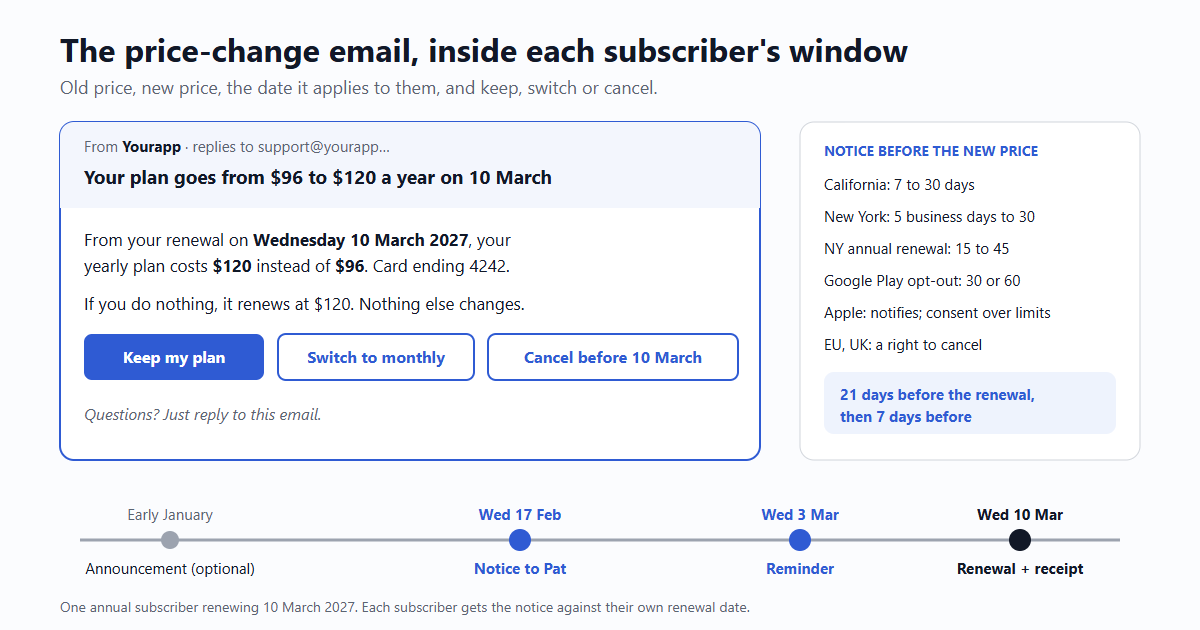
A small app has 400 subscribers on a $96-a-year plan and moves it to $120 for renewals from 1 February 2027. Pat renewed last on 10 March 2026, so Pat's first charge at $120 is Wednesday 10 March 2027.
- California window (7 to 30 days before): Monday 8 February to Wednesday 3 March.
- New York price-change window (5 business days to 30 days before): Monday 8 February to Wednesday 3 March.
- New York annual renewal notice (15 to 45 days before the cancel deadline, here the renewal day): Sunday 24 January to Tuesday 23 February.
- The overlap of all three: 8 to 23 February. One email on Wednesday 17 February can be both the renewal notice and the price notice. A short reminder on Wednesday 3 March, 7 days before, is still inside California's and New York's windows.
- In code:
notice_at = renewal - 21 days,reminder_at = renewal - 7 days, computed per subscriber. For a monthly plan the same two numbers work: 21 days and 7 days before the first renewal at the new price.
Does the rise pay if some people leave? Before: 400 × $96 = $38,400 a year. After, if 8% cancel: 368 × $120 = $44,160, which is $5,760 more. The break-even point is 1 − 96/120 = 20%: the app would have to lose one subscriber in five before the rise costs money. That is the number to have in mind before deciding whether to grandfather.
Grandfathering: three ways to do it
| Option | What subscribers get | Good for | The catch |
|---|---|---|---|
| Everyone moves at next renewal | New price from their next charge, with notice | Small rises, costs that went up for you too | The full churn risk lands at once |
| Grandfather for a period | Old price for 6 or 12 more months, then the new one | Larger rises; rewards early customers | Two notices: now, and again before it ends |
| Grandfather for good | Old price as long as they stay subscribed | Very early users, a few dozen people | The old price lives in your billing for years; say "as long as your subscription stays active" |
Whichever you pick, put it in the first paragraph. "Nothing changes for you until March 2028" is the sentence that keeps a subscriber reading calmly.
What the email says
- Subject with both prices and the date: "Your plan goes from $96 to $120 a year on 10 March". Not "An update to our pricing", which nobody opens and everyone later says they never saw.
- First lines, the whole change: "From your renewal on 10 March 2027, your yearly plan will cost $120 instead of $96. We'll charge the card ending 4242 on that day." Money, not percentages: Ofcom made UK phone and broadband providers state mid-contract rises in pounds and pence from 17 January 2025 for the same reason.
- Why, in two sentences. What got more expensive or what was added. A reason is also what the Rome court said the clauses lacked.
- What happens if they do nothing: the plan renews at the new price (or, where you ask for consent, it stops renewing).
- Three links: keep my plan, switch plan (monthly, or a smaller tier), and cancel before 10 March. The cancel link opens a page where one press cancels; California has required that "prominently located direct link or button" since July 2025.
- What stays the same: the features, their data, the renewal date.
- A reply that reaches someone. "Questions? Reply to this email." Some of the people who reply are asking for a discount; that is a cheaper conversation than a chargeback.
Leave out "exciting news", a percentage instead of the price, the change buried under a feature list, and a cancel link that goes to a chat.
The reminder a week before
Three lines: "On Wednesday 10 March we'll charge $120 for your next year (it was $96). Keep, switch or cancel: [link]. Questions? Reply to this email." Then, on the day, the normal receipt with the new amount; what a receipt has to carry is in the receipt email. If the person is still on a trial when the new price arrives, the trial reminder carries the new price instead (the trial-ending email).
Sending it from your app
A price notice is a transactional email: it goes to every subscriber, including people who never joined a newsletter, because it is about their contract (where the line is). Keep promotions out of it, or it stops being one. With Stripe Billing, the price on an existing subscription changes only when you swap the price on its subscription item (or schedule it); Stripe does not email a price-change notice for you, so the email is yours to send. With email59 it is one call per subscriber, with replies going to an inbox someone reads:
curl https://email59.com/v1/send \
  -H "Authorization: Bearer $EMAIL59_KEY" \
  -H "Content-Type: application/json" \
  -d '{
    "from": "yourapp",
    "to": "pat@example.com",
    "reply_to": "support@yourapp.example",
    "subject": "Your plan goes from $96 to $120 a year on 10 March",
    "text": "Hi Pat,\n\nFrom your renewal on Wednesday 10 March 2027, your yearly plan will cost $120 instead of $96. We will charge the card ending 4242 on that day.\n\nWhy: our hosting and support costs have gone up, and the plan now includes shared projects.\n\nIf you do nothing, your plan renews at $120 and everything else stays the same.\n\nKeep my plan: https://yourapp.example/billing\nSwitch to monthly ($11): https://yourapp.example/billing/plans\nCancel before 10 March: https://yourapp.example/billing/cancel\n\nQuestions? Reply to this email."
  }'
This is a summary for planning emails, not legal advice for your business.
Sources: Cal. Bus. & Prof. Code § 17602(g) and (h) as amended by AB 2863 (FindLaw text, Oct 2026; Kilpatrick Townsend, Oct 2024); N.Y. GBL § 527-a(1)(f)-(h) (NY Senate text, updated 7 Nov 2025; Perkins Coie on the 5 Nov 2025 amendment); Apple's May 2022 developer update as reported by TechCrunch and Macworld; Google Play Console Help "Price changes" country table and Android developer docs (Oct 2026); Council Directive 93/13/EEC Annex point 1(l); UK Consumer Rights Act 2015 Schedule 2; Legal Tribune Online on BGH I ZR 23/20 (Apr 2021); Il Sole 24 Ore and Reuters on the Rome ruling (Apr 2026); Ofcom price-rise rules (Jan 2025); Stripe docs "Change the price of existing subscriptions" (Oct 2026). The 400-subscriber example is our own arithmetic.
Apple, App Store, Google Play, Netflix, Spotify and Stripe are trademarks of their owners. email59 is not affiliated with them. This article is not legal advice.