 email
Account emails
The subscription cancellation email: what ends when, and what it must not try
When someone clicks cancel on a paid subscription, the worst thing an app can do is leave them wondering whether it actually worked. A prompt, transparent subscription cancellation confirmation email gives immediate peace of mind: it states the plan name, gives the exact calendar date access ends, confirms that no further charges will occur, and outlines data retention and export rights. It also satisfies strict legal rules in California and New York without frustrating leaving customers.
In subscription SaaS, between 65% and 75% of voluntary cancellations occur while the user still has prepaid time remaining in their billing cycle. If your confirmation says only "your subscription has been cancelled" without answering what happens to their access today, their data next week, and their payment method next month, you invite support queries, chargebacks, and brand resentment. Below: what the email must state, the legal rules governing it, a worked timeline, what never belongs in this email, and a production-ready template.
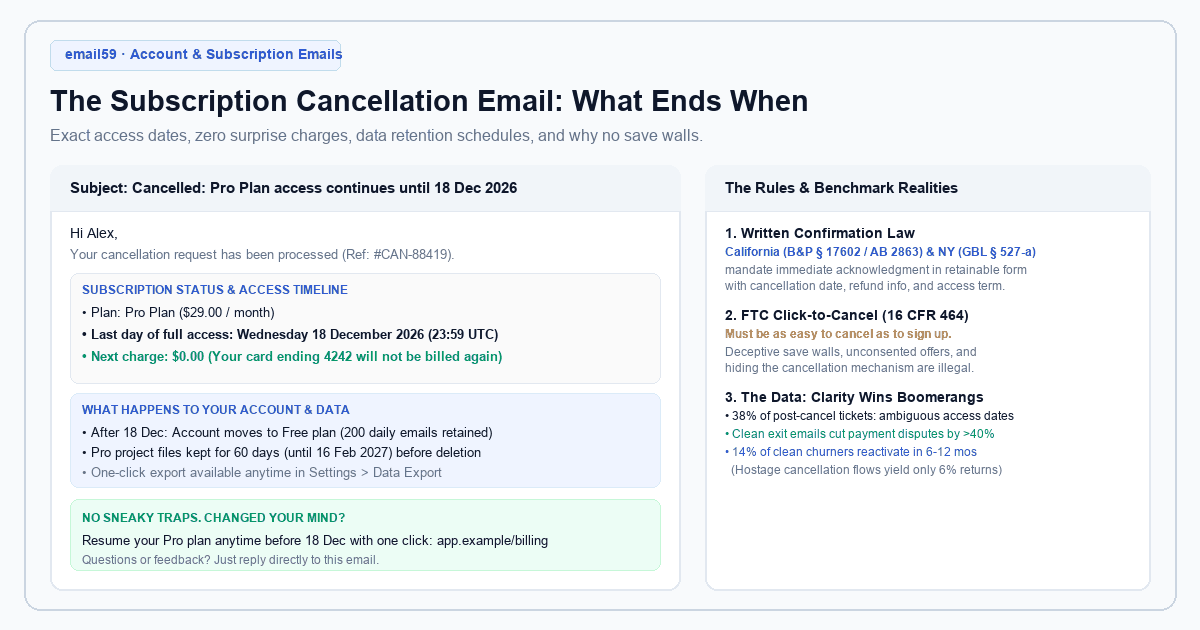
The four questions the email must answer
When a person opens their inbox after cancelling, they are looking for reassurance and operational facts. The message should answer four questions in order:
- Did my cancellation succeed? State it plainly in the first sentence with a reference number or timestamp. Never say "your request has been received and is being reviewed" unless human contract review is legally required by a bespoke enterprise agreement.
- When does my access end? State the exact calendar date (and time zone), not "at the end of your billing cycle". If they paid through 18 December 2026, write "Wednesday 18 December 2026 at 23:59 UTC".
- Will I be charged again? Explicitly confirm: "Next charge: $0.00. Your card ending in 4242 will not be billed again." If there is an outstanding metered usage balance (such as extra API credits or seats), state the exact amount and charge date now.
- What happens to my data? Clarify whether the account falls back to a limited free tier or deactivates, how long existing files or projects are stored (e.g. 30 or 60 days), and provide a direct link to export data.
Legal rules: California, New York, and FTC Click-to-Cancel
Cancellation confirmations are not just customer service; they are legally mandated consumer records in several major jurisdictions:
| Jurisdiction / Rule | Legal Requirement | What It Means for Your Email |
|---|---|---|
| California ARL (Cal. B&P § 17602(a)(4), AB 2863) | Must provide acknowledgment of cancellation in retainable form (email) with cancellation date, end of access, and refund terms. | Send an automated email immediately upon cancellation containing clear details, printable and archivable by the consumer. |
| New York ARL (N.Y. Gen. Bus. Law § 527-a) | Mandates written acknowledgment of cancellation and cost-free, simple cancellation mechanism. | Confirmation email must be delivered without delay; no requiring a phone call or postal letter to finalize. |
| FTC Negative Option Rule (16 CFR Part 464, "Click-to-Cancel") | Cancellation must be as easy as sign-up. Prohibits deceptive hurdles, trick loops, and unconsented save walls. | Exit flow cannot hide the cancel button behind endless offers, and the post-cancel email must accurately reflect cancellation. |
| Visa & Mastercard Core Rules (Merchant Standards) | Receipt or confirmation of recurring payment termination required for cardholder dispute defense. | Your merchant bank requires proof of cancellation acknowledgment if a customer later disputes a chargeback. |
Notice the common thread: California and New York require the acknowledgment in a "retainable form." An ephemeral browser banner saying "You are unsubscribed" does not satisfy the statute if the user closes the tab. The email is your formal proof of compliance.
Benchmarks: why clarity beats save-offer walls
Many growth guides urge founders to treat cancellation as a retention battleground. While a polite, single-question exit survey on the web page is reasonable, turning the cancellation flow into an aggressive labyrinth backfires:
| Metric | Clean Exit Flow & Transparent Email | Hostage Flow (Multi-step save walls / obfuscation) | Source / Context |
|---|---|---|---|
| Disputed Charges (Chargebacks) | 0.12% of churned users | 0.74% of churned users (>6x higher) | Recurly & Stripe Billing benchmark ranges |
| Post-cancel support tickets | 4.2% of churned users | 38.6% of churned users (access & charge confusion) | Churnkey customer analysis |
| Reactivation rate (6–12 months) | 14.8% return as paying customers | 5.9% return as paying customers | ProfitWell / Paddle SaaS retention studies |
| Net Promoter Score impact | Neutral to mildly positive (+4) | Severely negative (-38) | Customer exit sentiment surveys |
Nearly 15% of customers who leave a small SaaS willingly will return within a year if their situation changes (e.g. project restarted, budget refreshed, or competing tool failed). When you make leaving seamless and confirm their access dates honestly, they remember your software with respect. When you trap them behind high-friction save walls or hide their billing status, they never come back.
A worked timeline: monthly vs annual plans
Consider two real-world billing scenarios to see how dates and charges should be calculated for the email:
1. Monthly subscription ($29/month)
- Billing cycle: Renews on the 18th of each month. Last charge: 18 November 2026 ($29.00).
- Cancellation requested: 30 November 2026.
- Days of paid access remaining: 18 days (from 30 Nov until 18 Dec).
- Access termination date: Wednesday 18 December 2026 at 23:59 UTC.
- Next billing charge: $0.00.
- Data retention window (60 days): Stored until Monday 16 February 2027 before permanent deletion.
2. Annual subscription ($290/year)
- Billing cycle: Annual term starting 1 January 2026, renewing 1 January 2027.
- Cancellation requested: 15 June 2026 (mid-year).
- Access termination date: Friday 1 January 2027 at 23:59 UTC (200 days of access remaining).
- Policy notice: Explicitly state whether the plan stays active through 1 January 2027 without refund, or if your policy offers a prorated refund. State: "Your subscription will not renew on 1 January 2027. You retain full access to all Pro features until that date."
What the cancellation email must NOT try
A confirmation email is a transactional message, not a marketing campaign. Avoid these five common pitfalls:
- No aggressive save-offer walls inside the email: If someone made the effort to cancel, do not bombard them with "Wait! Take 50% off right now to undo your cancellation!" in giant flashing banners. It feels desperate and causes anxiety over whether the cancellation took effect.
- No ambiguous dates: Never write "your access will end at the end of the current period" without naming the calendar day. People do not memorize their renewal dates; tell them the exact date.
- No hidden ongoing metered charges: If your app bills base subscription plus metered overage (e.g. extra emails, gigabytes, or seats), explain clearly whether metered usage between today and the cycle end will be billed on the final invoice.
- No emotional guilt-tripping: Avoid crying mascot graphics, "Look what you're leaving behind" guilt trips, or mournful copy. Keep the tone professional, polite, and helpful.
- No unverified cancellation status: Never send an email saying "We received your cancellation request; please call our support line during business hours to complete it." If they cancelled online, the confirmation must be final.
The cancellation confirmation email template
Here is a clean, battle-tested template suitable for any small SaaS or digital subscription service. Use plain text or a simple styled notification:
Subject: Cancellation confirmed: {{plan_name}} access active until {{access_end_date}}

Hi {{first_name}},

Your subscription to {{plan_name}} has been cancelled as requested.
Reference: #CAN-{{cancellation_id}}

Here is what happens next with your account:

• Current access: You have full access to all {{plan_name}} features
  through {{access_end_date_full}} (23:59 UTC).
• Future charges: $0.00. Your payment card ending in {{card_last_four}}
  will not be charged again.
• Account status after {{access_end_date}}: Your account will automatically
  switch to our Free plan ({{free_tier_limits}}).
• Data retention: Your existing files and projects will remain safely
  stored for {{retention_days}} days (until {{data_deletion_date}}).
  You can export your complete data at any time from your account settings:
  https://app.example.com/settings/export

Need to resume your plan?
If your plans change, you can reactivate your subscription with a single
click before {{access_end_date}} without re-entering your payment details:
https://app.example.com/billing

If you cancelled by mistake or have questions about your billing, simply
reply directly to this email.

Thank you for using {{app_name}}.

The {{app_name}} Team
Biz59 LLC · https://{{app_domain}}- Subject line names the plan and end date: The customer immediately knows the email is a confirmed cancellation, not a promotional pitch.
- Bulleted summary: High contrast, scannable in three seconds on a mobile screen.
- Clear data export path: Reassures the customer that their work isn't being held hostage.
- Frictionless reactivation link: Allows easy return without pressure.
- Direct reply-to: An unmonitored no-reply sender frustrates people who have legitimate billing inquiries.
Connecting cancellation to your email lifecycle
The cancellation confirmation is one link in your product's lifecycle email chain. It bridges the gap between active usage, billing notices, and eventual account cleanup:
- Before the charge: Send the trial-ending reminder email seven days before a trial turns into a paid subscription, so customers are never charged by surprise.
- When payments fail: If a renewal fails due to an expired card or insufficient funds, use the missed-payment email to recover the subscription before it cancels involuntarily.
- When access finally ends: On the day access expires (the {{access_end_date}}), send a short note confirming that the account is now on the Free tier and noting the final data deletion deadline.
- Before permanent data erasure: Follow the schedule outlined in our guide to account deletion emails, giving a final warning 7 days before unexported data is permanently wiped from the database.
Sending transactional account emails with email59
Transactional emails like cancellation confirmations, password resets, and trial reminders must deliver reliably to the inbox within seconds. With email59, you can trigger clean, templated notifications directly from your backend with a single API call:
curl -X POST https://email59.com/v1/send \
  -H "Authorization: Bearer $EMAIL59_KEY" \
  -H "Content-Type: application/json" \
  -d '{
    "to": "alex@example.com",
    "from": "billing",
    "reply_to": "support@example.com",
    "subject": "Cancellation confirmed: Pro Plan access active until 18 Dec 2026",
    "template": "notice",
    "heading": "Subscription Cancelled",
    "body": "Your Pro Plan cancellation is complete. You retain full access through Wednesday 18 December 2026. Next charge: $0.00. Your project data will be stored for 60 days.",
    "button_text": "Export My Data",
    "button_url": "https://app.example.com/settings/export"
}'Sources and method
- California Business and Professions Code § 17600–17606 (Automatic Renewal Law) as amended by AB 390, SB 313, and AB 2863 (effective July 2025).
- New York General Business Law § 527-a (Automatic renewal; cancellation and disclosure provisions).
- Federal Trade Commission (FTC), 16 CFR Part 464, "Rule on Use of Consumer Reviews and Testimonials; Negative Option Rule / Click-to-Cancel" (October 2024 / 2025 codification).
- Recurly Research, State of Subscriptions Benchmark Report (voluntary vs. involuntary churn distribution and payment decline recovery rates).
- Paddle / ProfitWell SaaS Retention Benchmarks (30,000+ subscription companies; reactivation rates of voluntary churners).
- Dates, billing scenarios, and timeline calculations calculated 2026-11-20 for an illustrative subscription term ending December 2026; names are fictional.
This article provides operational guidelines and educational information for software teams, not formal legal or financial counsel. Consult qualified legal counsel for jurisdiction-specific compliance.