Small business email
Asking for a review by email: the one after delivery, and what the FTC says you can't offer for it
Most happy customers never write a review because nobody asked them at a good moment. BrightLocal's 2025 survey found 96% of consumers open to reviewing a local business, and only 29% had actually done so in the past year. One email, sent once the thing has arrived and been used, closes some of that gap. Since October 2024 there is also a US federal rule on what you may offer for a review and what you can't hide, and every review site has its own rules on top. Here is the email and the rules.
The short answer: ask about 7 days after delivery (later for things that take weeks to judge), ask one question with one link straight to the review form, send everyone the same request, not only the customers you think are happy, offer nothing in return on Google, Amazon or Etsy, and follow up at most once.
When to ask
Not at shipping: the customer has nothing to review yet, and a request in the shipped email reads as presumptuous. Ask once the item has arrived and been used.
| Days after fulfilment | Average response rate |
|---|---|
| 0 to 10 | 3.5% |
| 10 to 15 | 2.5% |
| 15 to 30 | 2.9% |
| 30 to 60 | 2.5% |
| 60 and more | 2.9% |
That is Stamped's data across more than 5,000 shops using its review app (vendor figures, sample method not published); it puts the best moment at about 10 days after the order ships, which for most parcels is about a week after it arrives. Things that take time to judge (skincare, supplements, plants, a mattress) earn a later ask, 2 to 4 weeks. A service is different: ask the same day or the next, while the visit is fresh.
A worked example. A walnut chopping board is delivered on Tuesday 3 November 2026. The request goes on Tuesday 10 November; the one follow-up, to people who haven't reviewed yet, on Tuesday 17 November. Sold on Amazon, the "Request a Review" window for that order runs from 8 November to 3 December (5 to 30 days after delivery). Sold on Etsy, the buyer can review until about 11 February 2027 (100 days from the estimated delivery date). A shop with 200 orders a month at Stamped's 3.5% gets about 7 reviews a month from the first email, roughly 84 a year, which is more than most small shops have in total.
What the email says
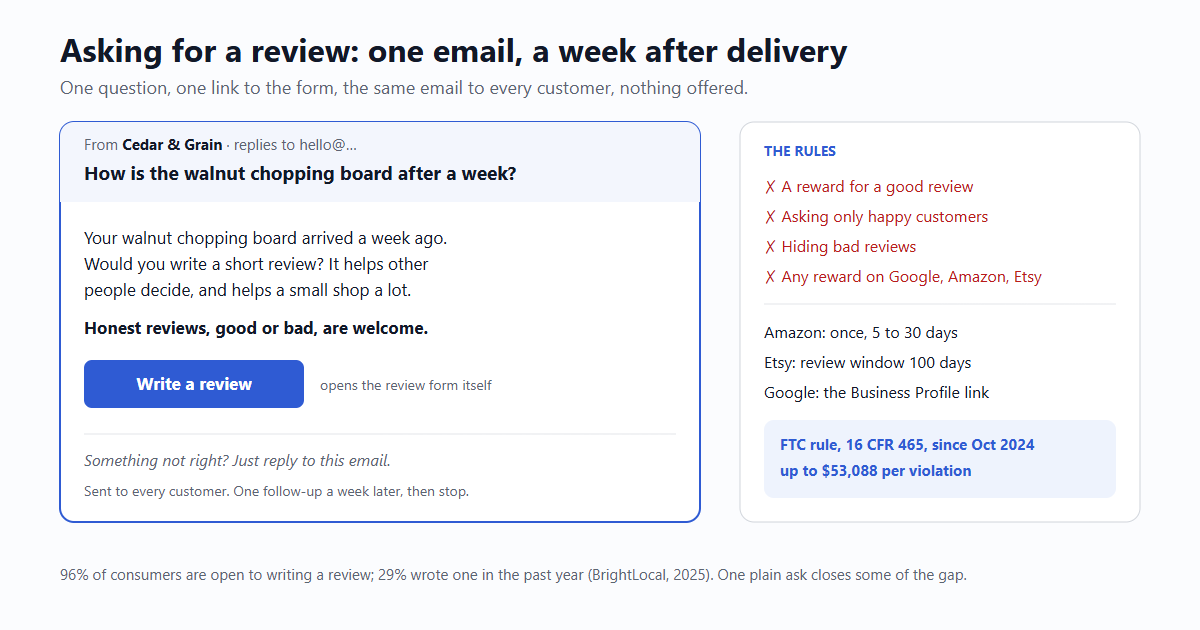
- Subject with the item: "How is the walnut chopping board after a week?" Not "We value your feedback!", which reads like every survey ever sent.
- One question and one button. "Would you write a short review? It helps other people decide, and it helps a small shop more than you'd think." Button: "Write a review".
- The button opens the review form itself, not your home page or the product page. Google: the review link from your Business Profile ("Ask for reviews" gives a short
g.page/r/…/reviewlink that opens the form). Your own shop: the product's review form, signed in or with the order number filled in. Each click you remove is a reviewer you keep. - "Honest reviews, good or bad, are welcome." It's true, it's what the rules expect, and reviews read as more believable with a few four-star ones among them.
- If something went wrong, a way to tell you: "Something not right? Just reply to this email." Offer it to everyone, under the review button, not instead of it (the next section is why).
Leave out stars to click inside the email that only send five-star clickers to Google, a discount code, and a long survey before the review link.
What the FTC rule says you can't do
The FTC's Rule on the Use of Consumer Reviews and Testimonials (16 CFR Part 465) took effect on 21 October 2024. It applies to any business that sells to US consumers, small shops included. The FTC sent warning letters to 10 companies on 22 December 2025, the first round under the rule; knowing violations can cost up to $53,088 per violation (2025 figure).
| Practice | Under the FTC rule | Google, Amazon, Etsy |
|---|---|---|
| A discount or gift for a positive review (or one tied to a star rating) | Banned (§ 465.4) | Banned |
| A discount or gift for any honest review, good or bad | Allowed, "as long as there isn't an express or implied requirement" of a particular sentiment | Banned: Google lists "payment, discounts, free goods and/or services"; Amazon and Etsy forbid incentives for reviews |
| Asking only customers you think are happy ("review gating") | No specific ban in the rule, but the FTC says it "could violate the FTC Act" | Google: businesses may not "selectively solicit positive reviews" |
| Hiding or deleting bad reviews on your own site while showing the rest as "all reviews" | Banned (§ 465.7) | Not possible on their sites |
| Threats or a contract clause against negative reviews | Banned (§ 465.7); form-contract gag clauses are also void under the Consumer Review Fairness Act 2016 | Banned |
| Reviews by staff or family | Allowed only with the relationship disclosed, visibly | Google: no conflict-of-interest reviews |
| Writing or buying fake reviews | Banned (§ 465.2) | Banned |
So the simple rule for a small shop selling on any platform: the same plain request to every customer, nothing offered, and a reply address for problems that is not a filter in front of the review link.
Marketplace rules
- Amazon: one review request per order, 5 to 30 days after delivery. The "Request a Review" button sends Amazon's own fixed email; with only one request allowed per order, use either the button or a buyer–seller message, not both. No follow-up.
- Etsy: buyers can review for 100 days from the order's estimated delivery date (from the first download for digital items). Asking once through Etsy messages is accepted practice; offering anything for the review isn't.
- Google Business Profile: ask anyone who bought or visited, with the review link; no incentives, no gating, no reviews from staff.
- Your own site: the FTC rule is what applies, plus showing every review you receive, including the low ones.
The follow-up, once
One more email a week later, only to people who haven't reviewed, shorter than the first: "In case it got buried: [Write a review]. Thanks either way." Then stop. A third ask turns a customer who meant to review into one who unsubscribes.
Is it a marketing email?
Mostly no: a request for feedback on an order the person placed is about that transaction, and the FTC's CAN-SPAM guidance treats emails whose main purpose is the transaction as transactional. Add a discount code, product recommendations or "you might also like", and its main purpose becomes selling, with the unsubscribe and consent rules that go with it (where the line is). Wherever you sell, keep it plain and include an opt-out link anyway. The email before it, the one that says the parcel is on its way, is in the shipping email article.
Sending it from your shop
Schedule it when the parcel is marked delivered (or the estimated date plus a day), cancel it if the order is returned or the customer complained, and send replies to an inbox someone reads. With email59 it is one call:
curl https://email59.com/v1/send \
  -H "Authorization: Bearer $EMAIL59_KEY" \
  -H "Content-Type: application/json" \
  -d '{
    "from": "yourshop",
    "to": "robin@example.com",
    "reply_to": "hello@yourshop.example",
    "subject": "How is the walnut chopping board after a week?",
    "template": "notice",
    "heading": "Would you write a short review?",
    "text": "Your walnut chopping board arrived a week ago. A short review helps other people decide, and helps a small shop more than you would think. Honest reviews, good or bad, are welcome.\n\nSomething not right? Just reply to this email.",
    "button_text": "Write a review",
    "button_url": "https://g.page/r/YOUR-ID/review"
  }'
This is a summary for planning emails, not legal advice for your business.
Sources: BrightLocal Local Consumer Review Survey 2025 (as summarised by Search Lab Digital); Stamped, "Best ways to optimize your review request emails" (vendor data, 5,000+ customers); FTC final rule 16 CFR Part 465 (Federal Register, Aug 2024) and "Consumer Reviews and Testimonials Rule: Questions and Answers" (Oct 2026); Greenberg Traurig and Venable on the FTC warning letters (Dec 2025); FTC civil penalty adjustment (Jan 2025); Consumer Review Fairness Act of 2016, 15 U.S.C. § 45b; Google Maps user contributed content policy "Fake engagement" (Oct 2026); Etsy Help "How to leave a review"; Amazon Request a Review rules as summarised by eComEngine and Payability; FTC "CAN-SPAM Act: A Compliance Guide for Business". The worked example is our own arithmetic.
Google, Amazon, Etsy, BrightLocal and Stamped are trademarks of their owners. email59 is not affiliated with them. This article is not legal advice.