 email
Email validation
We checked 30 made-up email addresses: 29 came back likely valid
Can an email checker tell you that a particular inbox exists? We gave email59 30 unique addresses with made-up names. All 30 requests completed. Twenty-nine came back likely valid; one came back risky. None came back invalid.
That does not mean 29 inboxes exist. It means their domains accept email and their names obey the visible rules. That distinction matters when you clean a customer list, guard a sign-up form or decide whether to send an important message.
How we ran the test
- We made 30 long, unique local parts in the form
weeklytest20261118x01q7z9. - We paired 15 with public mailbox providers such as Gmail, Outlook, Yahoo, iCloud and Proton Mail.
- We paired 15 with large-company domains such as GitHub, Apple, Stripe, Shopify and Salesforce.
- We called email59's public
/v1/checkendpoint once per address on 18 November 2026. - No email was sent. There was no SMTP conversation and no attempt to open an account.
The names were deliberately fabricated, but we cannot prove that an identical mailbox does not happen to exist. That is the point of the test: the checker sees the address and public DNS, not the provider's private mailbox directory.
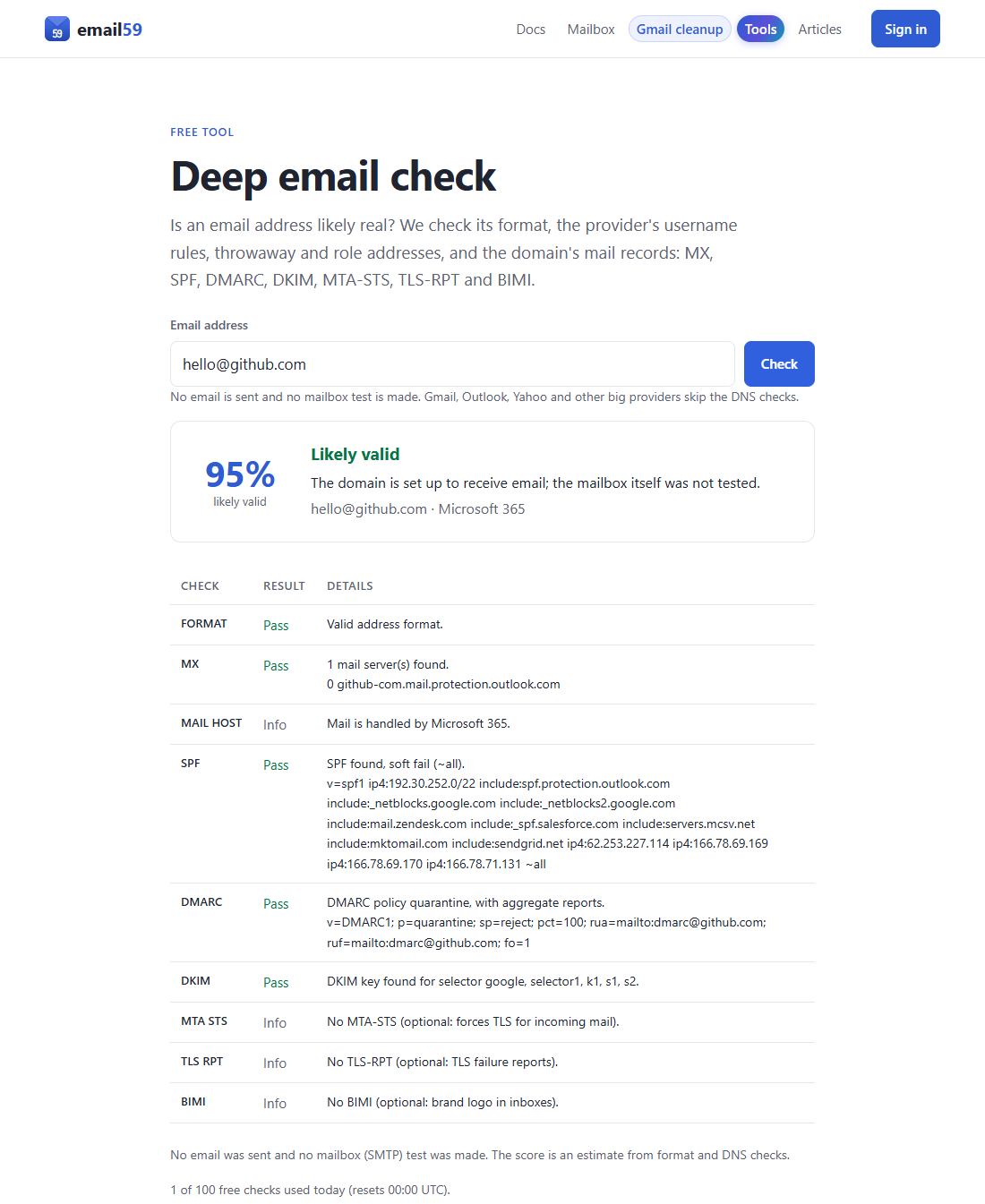
The result
| Group | Addresses | Likely valid | Risky | Likely invalid |
|---|---|---|---|---|
| Well-known mailbox providers | 15 | 15 | 0 | 0 |
| Large-company domains | 15 | 14 | 1 | 0 |
| Total | 30 | 29 | 1 | 0 |
Every request returned HTTP 200. The median response time was 865 ms; the fastest was 779 ms and the slowest was 2,440 ms.
Why the made-up names passed
For a well-known provider, email59 checks whether the username fits that provider's published shape. A long Gmail-looking name can score 99 even though the checker has no access to Google's account list.
For a business domain, it checks public mail setup: MX records, SPF, DMARC, common DKIM selectors and related records. Fourteen of the 15 business domains had enough public evidence to score as likely valid. notion.so was the one risky result. Again, that score describes the domain's visible setup—not the invented inbox name.
What a check can safely tell you
- Useful: the address is malformed, the domain does not exist, the domain has no mail server, the name breaks a known provider rule, or the domain is a known disposable service.
- Useful warning: a domain accepts mail but has incomplete or uncertain public setup.
- Not proof: that a particular person owns the address, reads it, or that the mailbox exists right now.
A checker that promises certainty without sending mail is promising access it usually does not have. Many providers hide mailbox answers to stop address harvesting. SMTP probing can also be blocked, misleading or harmful to sender reputation.
The practical answer
Use a DNS check before sign-up to catch obvious mistakes. Then verify ownership with a code or magic link. For an existing list, treat a positive check as permission to keep testing—not as proof that it is safe to mail.
Raw measurement
The test used 30 domains: Gmail, Outlook, Hotmail, Yahoo, iCloud, Proton, Zoho, GMX, mail.com, Fastmail, HEY, Tuta, AOL, Yandex, QQ, GitHub, Microsoft, Apple, Amazon, Stripe, Shopify, Atlassian, Slack, Dropbox, Notion, Canva, Zoom, Salesforce, HubSpot and Mailchimp. The source record keeps every domain, score, verdict and response time.